


How to Hire a Software Developer in 2026 — 7-Step Process for CTOs & Founders
How to Hire a Software Developer in 2026 — 7-Step Process for CTOs & Founders
Most companies take 60–90 days to hire a software developer. And after all that time, 1 in 3 technical hires doesn’t work out within the first year.
The process is broken — but it doesn’t have to be.
Whether you’re a non-technical founder hiring your first developer or a CTO scaling an existing team, this guide gives you a repeatable 7-step process that works in 2026.
Step 1 — Define What You Actually Need (Before You Post Anything)
The #1 reason technical hires fail is a poorly defined role.
Before writing a job description, answer these questions:
- What problem is this developer solving? (Not just “build features” — be specific)
- What’s the tech stack? (Frontend, backend, mobile, full-stack — be precise)
- What’s the seniority level? (Junior, mid, senior — honest assessment of your team’s management capacity)
- Is this a long-term hire or a defined project? (Full-time hire vs. staff augmentation)
- What’s the timeline? (How long can your sprint wait?)
Write a role requirements document — not just a job description. Include:
- Specific technologies required (e.g., “React 18, TypeScript, REST API integration”)
- Deliverables expected in the first 90 days
- Team structure they’ll work within
- Whether they’ll be managed or semi-autonomous
This document becomes your screening filter for every candidate.
Step 2 — Choose Your Sourcing Channel
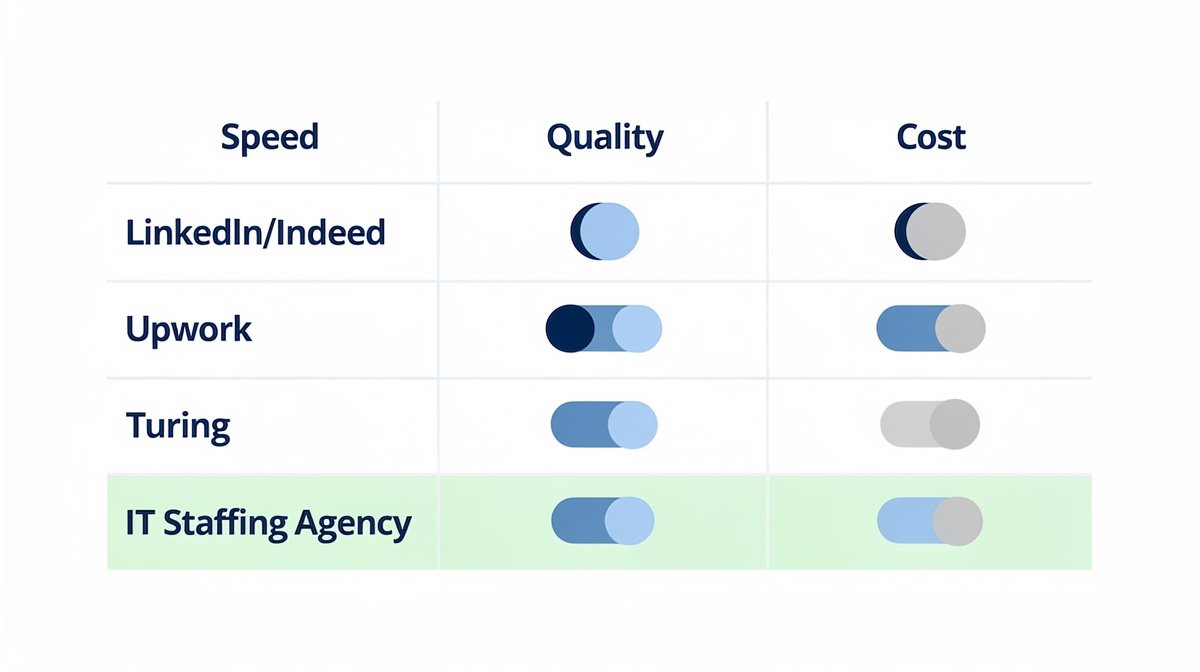
The software developer hiring process looks different depending on where you look.
| Channel | Speed | Quality | Cost |
| LinkedIn/Indeed | Slow (60–90 days) | Mixed | Low |
| Upwork/Freelancer | Medium (1–3 weeks) | Variable | Medium |
| Turing/Arc.dev | Fast (1–2 weeks) | Decent | High (per-hour markup) |
| Referrals | Fast (when available) | High | Low |
| IT Staffing Agency | Fast (7–14 days) | Pre-vetted | One-time fee |
For startup founders asking “how to find a good software developer” — referrals are your first call. Ask your network, your investors, your advisors. A warm referral shortens the screening process by weeks.
Step 3 — Write a Job Description That Filters, Not Just Attracts
Most job descriptions attract 200+ applicants and filter out zero bad ones.
A good technical JD includes:
Must-have (hard requirements):
- Specific technologies with version/depth (not just “React” — “React 17+, Hooks, Redux”)
- Years of professional experience (be realistic — most “senior” roles need 4+ years)
- Portfolio or GitHub link required
Nice-to-have (separates candidates):
- Specific domain experience (e-commerce, fintech, healthcare, SaaS)
- Open-source contributions
- Experience with your specific architecture
Remove from your JD:
- “Ninja”, “rockstar”, “guru” — signals a bad hiring culture
- Laundry lists of 20+ technologies — no one has all of them
Step 4 — Technical Screening (Don’t Skip This)
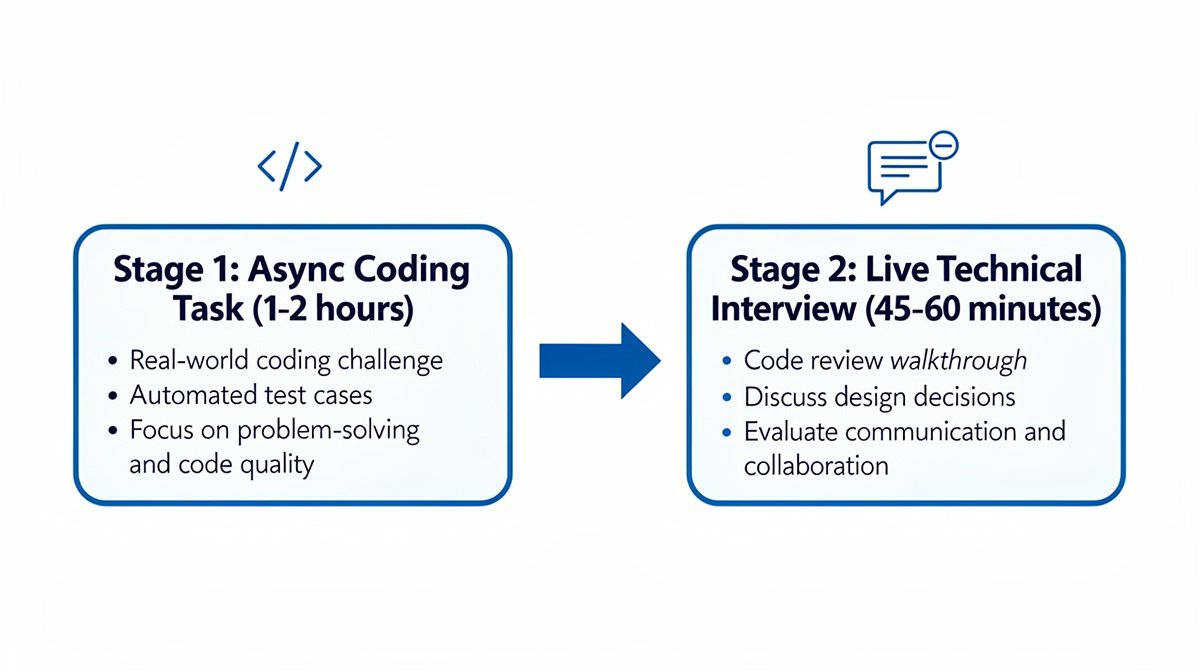
This is where most hiring software developers for startups goes wrong.
Two-Stage Technical Screen
Stage 1 — Async coding task (1–2 hours):
Send a small, real-world task. Not a trick puzzle. Something like:
- Build a simple REST API endpoint with authentication
- Fix a bug in a provided React component
- Write a SQL query against a sample schema
Stage 2 — Live technical interview (45–60 minutes):
Walk through their solution. Ask:
- Why did you structure it this way?
- What would you change if the dataset was 10× larger?
- How would you test this in production?
Key Red Flags in Technical Screens
- Can’t explain their own code
- Refuses to take the coding test (“my portfolio should be enough”)
- Solution works but has no error handling or edge case consideration
Step 5 — Run Structured Software Developer Interview Questions
Use the same questions with every candidate so you can compare fairly.
Technical Questions
- “Walk me through how you’d architect [a specific feature in your product].”
- “Describe the most complex bug you’ve ever debugged. How did you find it?”
- “What’s your experience with testing? Show me a test you’ve written.”
Process and Collaboration Questions
- “How do you handle a disagreement with a product manager about scope?”
- “Describe your workflow from ticket to production deployment.”
- “How do you stay current with changes in your stack?”
Red Flags in Interviews
- Blames previous teams without any self-reflection
- Can’t recall specifics about “their” past projects
- Dismisses testing or documentation as “not their job”
Step 6 — Check References (Actually Call Them)

Call the reference directly. Ask:
- “Would you hire this developer again — yes or no?”
- “What type of work did they do best?”
- “What kind of management did they need to do their best work?”
- “Is there anything I should know to set them up for success?”
The last question gets you the most honest answer.
Step 7 — Make a Decision (Don’t Let It Drag)
The average US company takes 23 days to make a final offer after interviews complete. In a competitive developer market, your top candidate accepted another offer on day 10.
Move fast:
- Set a 48-hour decision window after final interviews
- Have the offer letter ready before the final round
- Be clear about the process timeline from day one
Shortcut: Skip Steps 1–5 and Work With a Staffing Agency
If you don’t have the bandwidth to run a full hiring process, a staffing agency does steps 1–5 for you.
You get:
- Pre-defined role requirements based on your brief
- Sourced, screened, and tested candidates
- Only qualified developers to interview (you run steps 5–7)
- A dedicated account manager handling logistics
❓ Frequently Asked Questions — How to Hire a Software Developer
Q: How long does it take to hire a software developer in the USA?
A: The average US company takes 60–90 days to hire a software developer through traditional job boards. With a staffing agency, the timeline drops to 7–14 days. The biggest delays come from undefined role requirements, slow technical screening, and delayed offer decisions — all fixable with the right process.
Q: How much does it cost to hire a software developer in 2026?
A: Full-time software developer salaries in the USA range from $90,000–$185,000/year depending on stack and seniority. Freelance rates run $50–$150/hr. Staffing agency placement fees are typically 15–20% of first-year salary (one-time). Platforms like Turing/Toptal charge ongoing per-hour markups that cost more over 12+ months than a direct placement.
Q: What is the best way to find a good software developer?
A: Start with referrals — warm network introductions are fastest and highest quality. If your network is dry, use an IT staffing agency for pre-vetted candidates. Avoid relying solely on LinkedIn or Indeed for technical roles — the volume of unqualified applicants makes screening extremely time-consuming without a dedicated recruiter.
Q: What should I test in a software developer interview?
A: Run a 2-stage screen: first an async coding task (1–2 hours, real-world problem), then a live code review where you walk through their solution together. Skip trivia questions. Focus on architecture thinking, debugging approach, and how they explain technical decisions. A developer who can’t explain their own code is a red flag regardless of the quality of the output.
Q: How do I hire a software developer if I’m non-technical?
A: Bring in a technical advisor or fractional CTO to run the screening and interview. Use a staffing agency that handles vetting for you — they present only pre-qualified candidates. Focus your energy on evaluating communication, problem-solving approach, and professionalism. You don’t need to understand every line of code to make a good hire — but you need a trusted technical voice in the room.
Q: What are the most common mistakes when hiring software developers?
A: The top 5 mistakes: (1) no technical screening before interviews, (2) job descriptions with 20+ required technologies, (3) moving too slowly — losing candidates to competing offers, (4) skipping reference checks, (5) confusing “has used the technology” with “is proficient in the technology.” Requiring a GitHub link in the JD eliminates 60% of unqualified applicants immediately.
Frequently Asked Questions – How to Hire a Software Developer
What is the fastest way to hire a software developer in 2026?
The fastest method is through a US IT staffing agency – average placement time is 5-14 business days. Freelance platforms take 1-3 weeks. Job boards take 45-90 days. If speed matters, skip job boards.
What should I ask in a software developer technical interview?
Cover system design for senior roles, real-scenario problem-solving, code review exercises, past architecture decisions, and how they handle production incidents. Avoid algorithm puzzles unrelated to your actual stack.
How do I evaluate a software developer’s portfolio?
Ask what their specific contribution was (not just team output), check GitHub commit history, and ask about technical decisions they made and why. A strong portfolio shows consistent shipping, not just impressive demos.
What is a reasonable technical assessment for a software developer?
A 2-3 hour take-home project or a 1-hour live coding session. Avoid unpaid multi-day projects – they filter out employed senior developers. The assessment should reflect real work from the role.
Should I hire a software developer as an employee or contractor?
Hire as an employee for long-term roles (12+ months) or those requiring deep product knowledge. Use contractors for defined projects or speed-to-hire needs. Contract-to-hire reduces risk for both sides.
How do I retain a software developer after hiring?
Pay market rates, provide clear growth paths, involve developers in architecture decisions, minimize unnecessary meetings, give good tooling, and provide meaningful project ownership. Developers leave bad managers and boring work.
Final Words
The software developer hiring process doesn’t have to take 90 days.
Follow these 7 steps and you’ll cut that timeline in half — and make better hires.
If you want to skip straight to qualified candidates — we’ve already done steps 1–5.
👉 Book a free 15-minute call — tell us your stack and timeline. We’ll show you who’s available.
🔹
