


How to Hire Remote Developers for Your US Team — The Complete 2026 Guide
How to Hire Remote Developers for Your US Team — The Complete 2026 Guide
Remote developer hiring is no longer a backup plan. It’s the primary strategy for most US companies building software in 2026.
The talent shortage is real. Local developer pools in most US cities can’t keep up with demand. Remote hiring gives you access to a global talent pool — if you know how to do it right.
This guide covers everything: sourcing, vetting, legal compliance, onboarding, and day-to-day management of remote software developers working with your US team.
Why US Companies Hire Remote Developers
The numbers explain the shift:
- 43% of US tech companies now have fully distributed engineering teams
- Remote developers cost 30–60% less than equivalent US-based hires when sourced from strong developer markets
- Time-to-hire drops significantly when you’re not restricted to local geography
- Developer retention is higher when developers have location flexibility
The challenge isn’t finding remote developers. It’s finding the right ones and building a workflow that makes remote actually work.
Where to Find Remote Developers Worth Hiring
Option 1: Freelance Platforms
Upwork, Toptal, Turing, Arc.dev
- Wide talent pool, fast to browse
- You run your own vetting (time-consuming)
- Per-hour platform markups add up fast over 12+ months
- Best for short-term or project-based work
Option 2: Direct LinkedIn Sourcing
- Time-intensive — requires writing outreach at scale
- Hit rate is low (10–20% response rate)
- Works best when your company brand is strong
- Good for senior specialists with niche skills
Option 3: IT Staffing Agency (Best for Long-Term)
- Developers are pre-vetted (technical screen done)
- US account manager handles compliance, onboarding logistics
- One-time placement fee — no monthly markup
- Fastest time-to-placement: 7–14 days
For hiring remote software developers for US companies long-term, a staffing agency eliminates the most painful part — sorting through unqualified candidates — and gets you to an interview-ready shortlist in days.
How to Vet Remote Developers — The Right Way
Vetting remote developers is different from vetting in-person hires. Your screening process has to do more work.
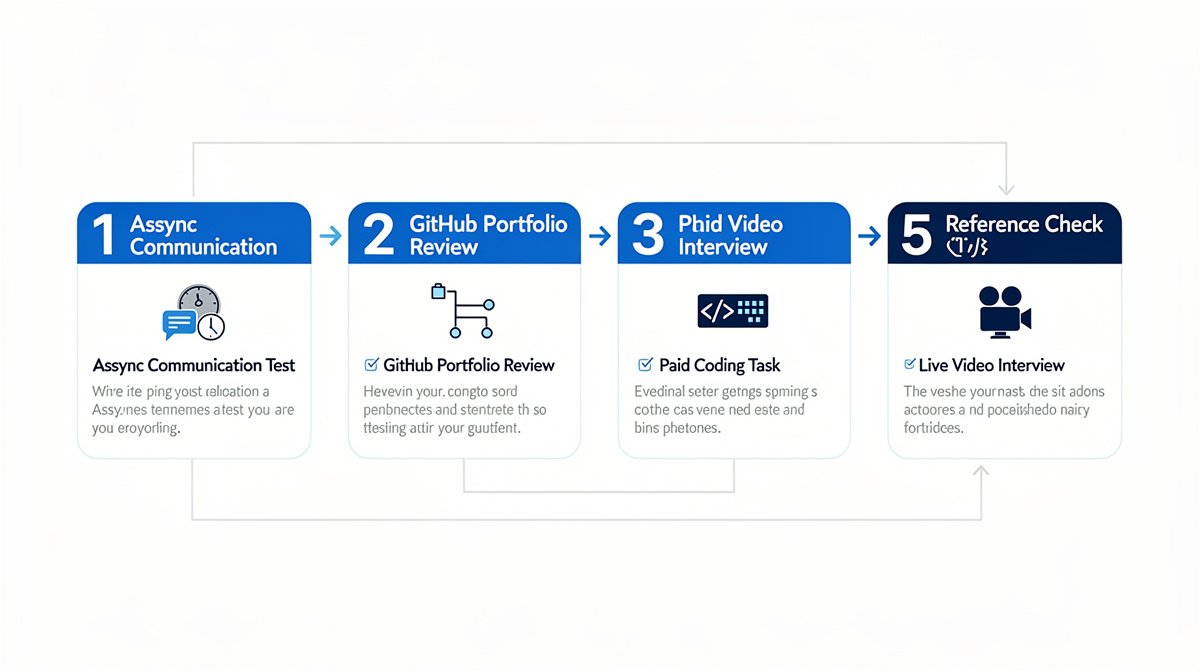
Step 1 — Review Their Async Communication First
Before any technical screen, send a short written brief and ask for a written response. What you’re testing:
- Can they read and understand requirements clearly?
- Is their written English professional and precise?
- Do they ask the right clarifying questions?
Poor async communicators are a critical failure point in remote teams. Filter this early.
Step 2 — GitHub / Portfolio Review
Check their actual code, not just their resume:
- Look for recent commits (not just old repos)
- Review code quality: naming conventions, comments, structure
- Check commit messages — they reveal work habits and communication style
- Look for contributions to real projects, not just tutorial repos
Step 3 — Async Coding Task
Give a 2–3 hour task that mirrors real work on your stack. Key rules:
- Pay for it ($50–$100 for their time)
- Set a realistic deadline (24–48 hours)
- Review both the solution AND the questions they asked during it
Step 4 — Live Technical Interview (Video, Camera On)
This is non-negotiable. Camera on, screen share enabled. Walk through their code solution together. Red flags if they:
- Can’t explain their own solution
- Get defensive when you probe their choices
- Have camera/mic issues that are “always acting up”
Step 5 — Reference Check
Call 2 previous managers or senior colleagues. Ask the same 4 questions:
- “Would you hire this developer again — yes or no?”
- “What kind of work did they do best?”
- “What level of management did they need?”
- “Anything I should know to set them up for success?”
Legal & Compliance: What US Companies Must Get Right
Independent Contractor vs. Employee
Most remote developers working across borders are engaged as independent contractors. This is fine — but the classification must be legitimate. Work with your legal counsel or a PEO to classify correctly.
Contractor Agreement Essentials
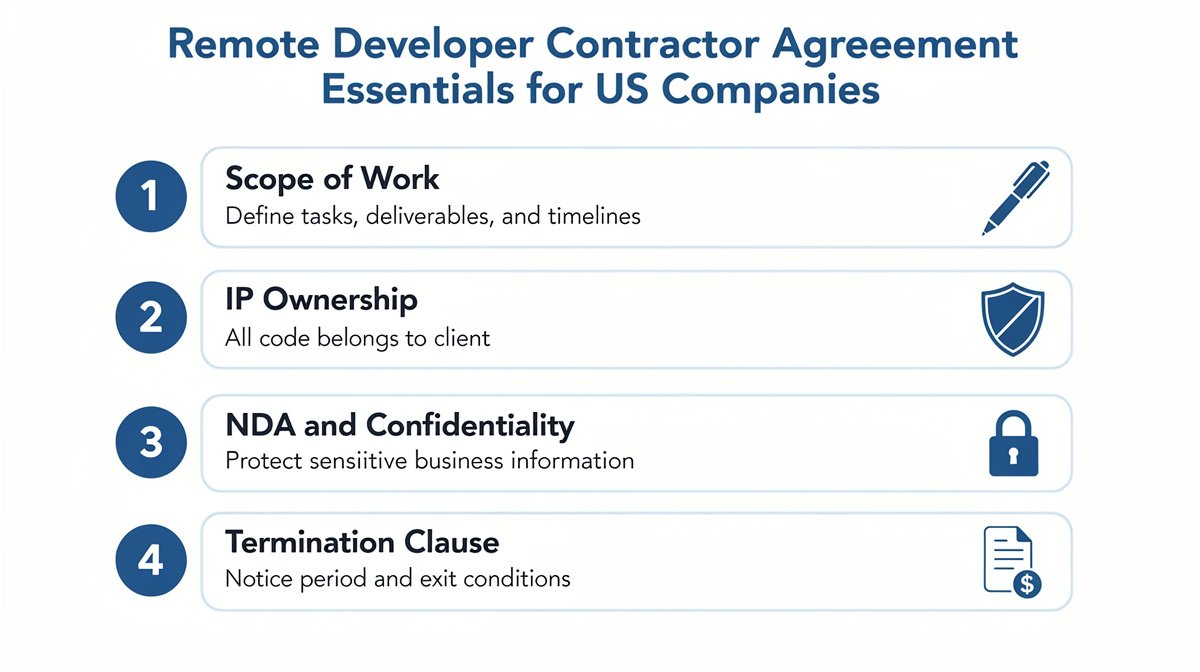
Every remote developer onboarding process must include a signed agreement covering:
- Scope of work — exactly what they’re building
- IP ownership — all code written for you is owned by you
- Confidentiality / NDA — protecting your product and data
- Payment terms — amount, currency, frequency, invoicing process
- Termination clause — notice period, deliverables required on exit
Remote Developer Onboarding Best Practices
Week 1 — Access & Context
- [ ] All system access provisioned (GitHub, Jira, Slack, AWS, etc.)
- [ ] Architecture overview session (1 hour with a senior dev)
- [ ] Codebase walkthrough (recorded for future reference)
- [ ] First small task assigned — low stakes, real work
Week 2 — First Contribution
- [ ] First PR submitted and reviewed
- [ ] Daily standup participation
- [ ] 1-on-1 with engineering lead
Week 3–4 — Integration
- [ ] First full feature ownership
- [ ] Feedback session: what’s working, what’s not
- [ ] Introduced to cross-functional stakeholders
Managing a Remote Development Team — What Actually Works
Communication Rhythm
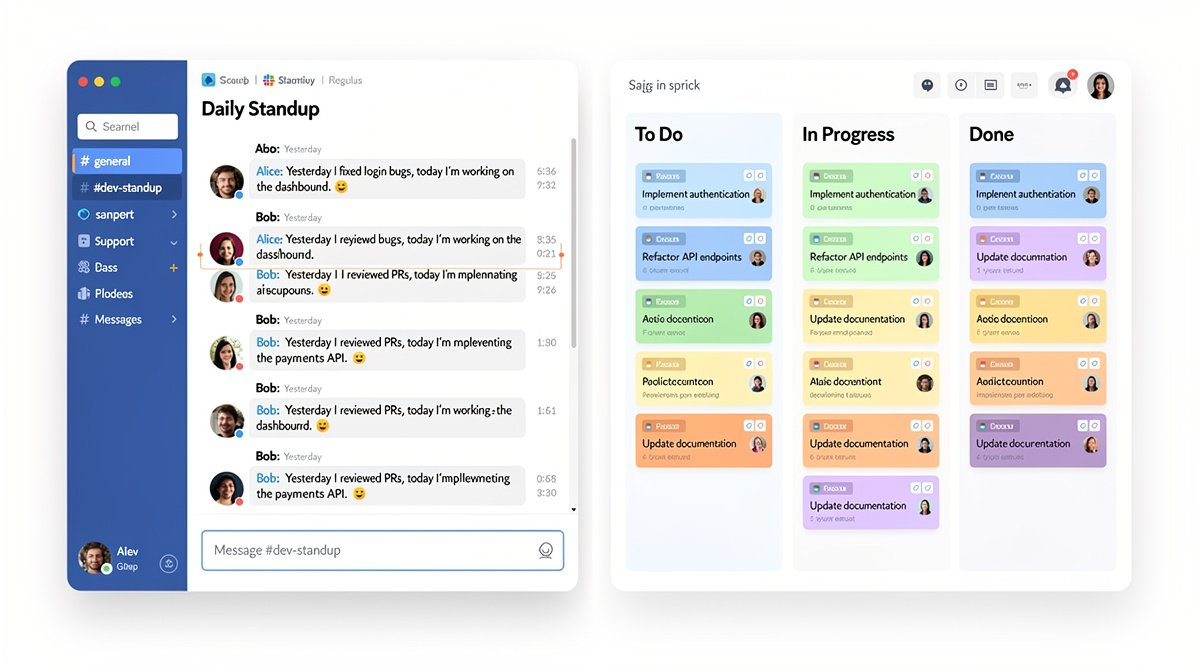
- Daily async standup (written in Slack): What did you do? What will you do? Any blockers?
- Weekly sync call: 30–45 min. Priorities, blockers, demos.
- Monthly 1-on-1: Career, feedback, engagement check.
Documentation Culture
Remote teams live or die by their documentation. Every decision, architecture choice, and process should be written down and findable.
Measurement: Output, Not Hours
Don’t track hours. Track deliverables. Define sprint goals clearly. Review them weekly. Adjust based on output, not presence.
Time Zone Management
Set a 2–3 hour overlap window where everyone is available for sync communication. Most US-to-Pakistan or US-to-Eastern-Europe teams manage overlap well with a morning-start policy on the offshore side.
❓ Frequently Asked Questions — How to Hire Remote Developers
Q: How do I hire remote software developers for a US company?
A: The fastest path for US companies is through an IT staffing agency that maintains a pre-vetted remote developer pipeline. They handle sourcing, technical screening, compliance paperwork, and contractor agreements. You receive a shortlist of qualified candidates in 7–10 days and interview only pre-screened developers. Alternatively, platforms like Turing and Arc.dev offer self-serve access to vetted remote developers but require you to run your own technical screening.
Q: What is the best country to hire remote developers for US companies in 2026?
A: Pakistan, Eastern Europe (Poland, Ukraine, Romania), and Latin America (Mexico, Colombia, Argentina) are the top markets for US companies. Pakistan offers strong English proficiency, excellent React/Python/Flutter talent, and rates 40–60% below US equivalents with significant timezone overlap during US afternoon hours. Eastern Europe offers similar quality at slightly higher rates with better timezone alignment for East Coast companies.
Q: How much does it cost to hire a remote developer from Pakistan or Eastern Europe?
A: Remote developer rates from Pakistan typically run $25–$55/hr for mid-to-senior level talent. Eastern Europe runs $40–$80/hr. Compare this to $80–$150/hr for equivalent US-based developers. Over a full year, a Pakistan-based mid-level developer saves US companies $60,000–$100,000 versus a local hire — without sacrificing technical quality when vetted properly.
Q: How do I legally hire a remote developer outside the USA?
A: Most US companies engage international developers as independent contractors under a written contractor agreement. The agreement must clearly define scope of work, IP ownership (all code belongs to your company), payment terms, and confidentiality. For longer-term engagements or employee-level classification, consider an Employer of Record (EOR) service. Always consult legal counsel on contractor classification to avoid misclassification risk.
Q: How do you manage a remote development team effectively?
A: The 4 principles that work: (1) daily async standups in Slack instead of video calls, (2) weekly 30-minute sync for priorities and demos, (3) measure sprint output not hours logged, (4) document everything in a shared knowledge base. Set a 2–3 hour overlap window where the remote team is available for sync communication. Over-communication in writing beats over-meeting on video.
Q: What are the biggest risks of hiring remote developers and how do you avoid them?
A: The 4 main risks: (1) Skill misrepresentation — mitigated by live coding interviews and paid async tasks; (2) Communication gaps — mitigated by async communication screening before technical rounds; (3) IP and legal exposure — mitigated by a solid contractor agreement; (4) Onboarding failure — mitigated by a structured 30-day onboarding plan with clear early deliverables. Most remote hiring failures trace back to skipping one of these four safeguards.
Frequently Asked Questions – How to Hire Remote Developers
What are the best countries to hire remote developers for US companies?
Poland, Ukraine, Romania, and Serbia offer strong senior engineering talent with partial US time-zone overlap. Latin America (Argentina, Colombia, Brazil) offers EST/CST overlap. India and Vietnam offer scale at lower cost.
How do I manage a remote developer team effectively?
Use async-first communication (Slack, Notion, Loom), document decisions thoroughly, run structured weekly syncs, use Jira or Linear for task visibility, and hold monthly 1:1s. Avoid expecting real-time responses across time zones.
Do I need a local entity to hire remote developers internationally?
No. Use Employer of Record (EOR) services like Deel, Remote.com, or Rippling to hire internationally without setting up a local entity. For independent contractors, a standard services agreement is typically sufficient.
How do I protect IP when hiring remote developers?
Use clear IP assignment clauses and NDAs in your contract, private repositories with access controls, and revoke all access immediately upon contract end. Work with a US attorney to review international contracts.
What is the difference between a remote developer and an offshore developer?
Remote refers to the working arrangement (not co-located). Offshore refers to location (different country). All offshore developers are remote, but remote developers can also be US-based. Most US companies use both.
How do I onboard a remote developer successfully?
Prepare written onboarding docs covering architecture, tooling, and team norms before day one. Assign a buddy developer for two weeks. Set 30/60/90-day milestones. Daily check-ins for week one, then weekly. Good onboarding cuts ramp-up time by 40-50%.
Final Words
Remote developer hiring is one of the highest-leverage decisions your company can make in 2026.
The companies that get it right — with proper vetting, clear contracts, and a strong onboarding process — build development teams that outperform their US-only counterparts on cost AND output.
We help US companies hire remote software developers the right way — pre-vetted, compliant, and placed in 14 days with a dedicated US account manager handling the logistics.
👉 Book a free 15-minute call — let’s talk about your team and your timeline.
🔹
