


Top Staff Augmentation Companies in the USA — How to Choose the Right One (2026)
Top Staff Augmentation Companies in the USA — How to Choose the Right One (2026)
Your development team is behind. Sprints are slipping. You can’t afford to wait 90 days to hire.
Staff augmentation is the fastest way to add vetted developer talent to your team — without the overhead of a full-time hire. But not all staff augmentation companies in the USA deliver the same quality.
This guide shows you exactly what to look for, what questions to ask, and how to get a developer contributing to your sprints within 2 weeks.
What Is IT Staff Augmentation?
IT staff augmentation is a hiring model where you bring in external developers to work as part of your team — temporarily or long-term — without the cost and process of a traditional full-time hire.
Think of it like adding a player to your roster mid-season. They play under your direction, follow your processes, and report to your engineering lead. The staffing agency handles the sourcing, vetting, payroll, and compliance.
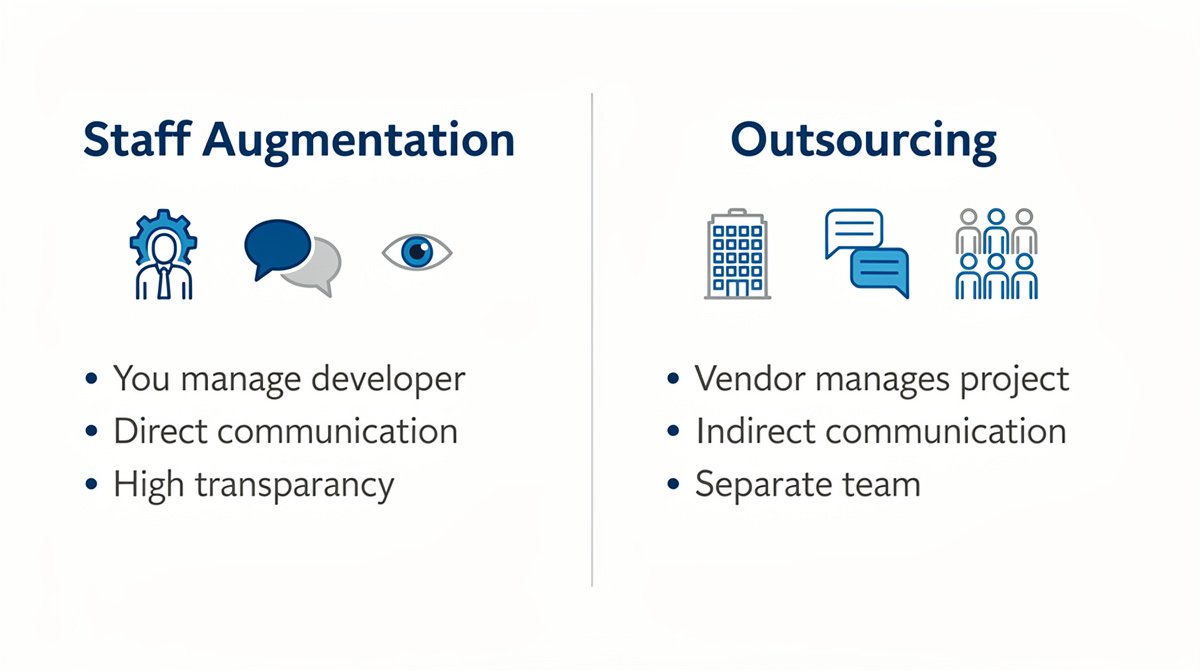
Staff Augmentation vs. Outsourcing — Key Difference
| Staff Augmentation | Outsourcing | |
| Control | You manage the developer | Vendor manages the project |
| Integration | Developer joins your team | External team works separately |
| Communication | Direct | Through project manager |
| Best for | Adding to an existing team | Handing off an entire project |
| Transparency | High | Variable |
Most US companies scaling a product team need developer staff augmentation — not full outsourcing. If you have an engineering lead and a defined process, augmentation gives you control without the management overhead of a separate vendor team.
What Makes a Good Staff Augmentation Company?
Not all vendors are equal. Here’s what separates reliable IT staff augmentation services from ones that waste your time and money.
1. Technical Vetting Depth
Ask directly: “What does your vetting process look like?”
A credible answer includes:
- Live coding test (not just a resume review)
- GitHub portfolio review
- Technical interview by a domain expert
- Reference checks from previous clients
If they say “we screen for culture fit and communication,” that’s a red flag. You need technical screening, not soft-skills filtering.
2. Time to First Candidate
- Under 7 days: Strong pipeline
- 7–14 days: Acceptable
- 15+ days: They’re searching from scratch
The best staff augmentation companies in the USA maintain active, pre-vetted pipelines. They’re not posting a job ad when you call them — they already have candidates ready.
3. Replacement Guarantee
Things don’t always work out. A developer may not be the right culture fit, or their skill depth may not match the role. Any serious augmentation firm offers a replacement guarantee — typically 30–90 days.
Ask: “What’s your replacement policy if the developer doesn’t work out?”
4. US-Based Account Management
You need a single point of contact who understands your industry, your stack, and your timeline. Not a ticket system. Not a call center.
This matters especially for US companies working with offshore developer talent — someone needs to bridge the time zone, culture, and communication gaps professionally.
5. Compliance and Contractor Agreements
Depending on how developers are classified, there are legal considerations around contractor agreements, IP rights, and tax compliance. A professional augmentation firm handles these — and protects you from misclassification risk.
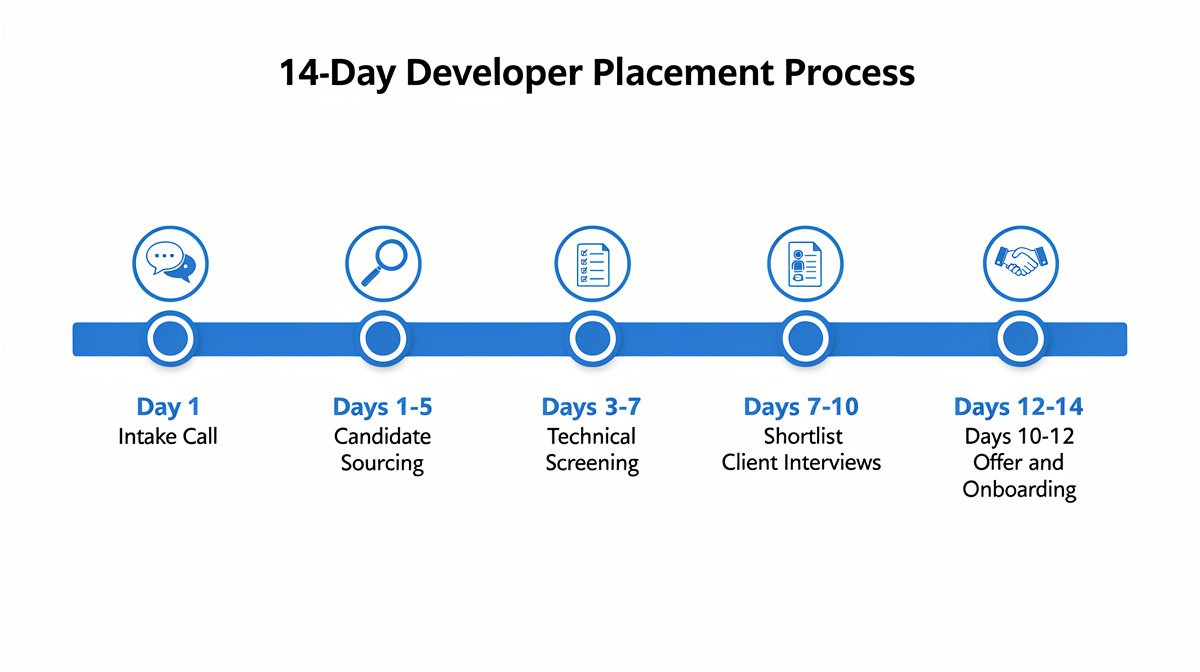
8 Questions to Ask Any Staff Augmentation Company Before You Sign
- “What stacks do you cover?” — Make sure they have deep coverage in your stack.
- “What does your vetting process look like step by step?” — Listen for specifics, not vague claims.
- “How long until I see the first candidate?” — Under 14 days is the benchmark.
- “Do you have candidates ready in our stack right now?” — Tests pipeline depth.
- “What’s your replacement guarantee?” — 30–90 days is standard.
- “Who is my account manager and how do I reach them?” — No tickets, no queues.
- “How do you handle compliance and contractor agreements?” — Protects your legal exposure.
- “What does the engagement look like after placement?” — Do they disappear, or stay involved?
How IT Staff Augmentation Actually Works — Step by Step
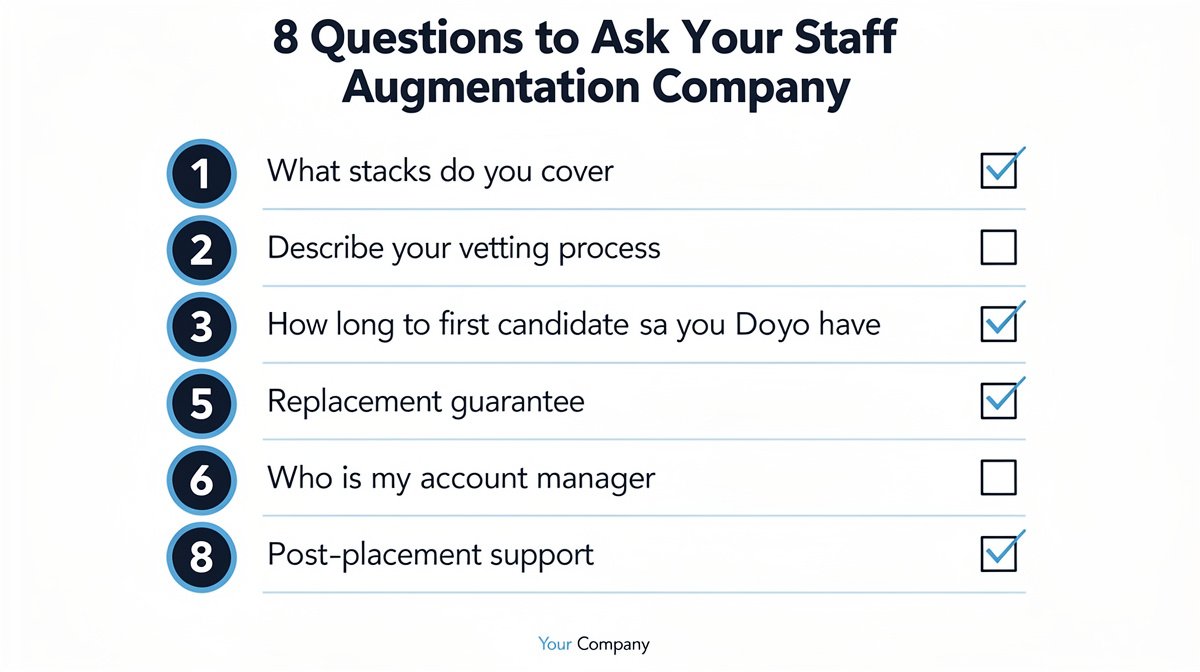
Step 1 — Intake call (Day 1): You share the role requirements — stack, seniority level, timezone preference, engagement length.
Step 2 — Candidate sourcing (Days 1–5): The agency searches its pre-vetted pipeline and sources additional candidates if needed.
Step 3 — Technical screening (Days 3–7): Candidates complete coding tests, portfolio reviews, and technical interviews.
Step 4 — Shortlist presentation (Day 7–10): You receive 2–3 pre-qualified candidates with profiles, test results, and availability.
Step 5 — Your interview (Day 10–12): You interview only qualified candidates — not a stack of resumes.
Step 6 — Offer and onboarding (Day 12–14): You select your developer. Agreements are signed. Onboarding begins.
Total: 14 days from intake call to developer on your team.
How to Choose a Staff Augmentation Company — The Shortlist Criteria
- [ ] Technical vetting includes a live coding test
- [ ] First candidate in under 14 days
- [ ] Replacement guarantee of 30+ days
- [ ] US-based account manager (not just email support)
- [ ] Clear contractor/compliance documentation
- [ ] Proven experience in your specific tech stack
- [ ] Transparent pricing (no hidden per-hour markups after placement)
❓ Frequently Asked Questions — Staff Augmentation Companies USA
Q: What is IT staff augmentation and how does it work?
A: IT staff augmentation is a hiring model where you add external developers to your existing team — temporarily or long-term — without the process of a full-time hire. The staffing company sources, vets, and places the developer. You manage their day-to-day work directly. The agency handles sourcing, compliance, and contractor paperwork.
Q: How much do staff augmentation services cost in the USA?
A: Cost depends on the engagement model. Most US IT staff augmentation services charge either an hourly markup on top of the developer’s rate, or a one-time placement fee (15–20% of annual salary for direct placement). For a developer earning $100,000/year, a one-time fee is typically $15,000–$20,000 with no further markup. Ongoing hourly markup models can cost 20–40% more per year.
Q: What is the difference between staff augmentation and outsourcing?
A: In staff augmentation, the developer joins your team, follows your process, and reports to your lead. You have full control and direct communication. In outsourcing, you hand off a project or function to an external vendor who manages their own team. Augmentation is better when you have an existing engineering team. Outsourcing works for standalone projects with defined deliverables.
Q: How long does it take to get a developer through staff augmentation?
A: A quality staff augmentation company in the USA with an active pre-vetted pipeline should present the first candidate within 7–10 days of your intake call. Full placement — including your interviews and offer signing — typically completes in 12–14 days. Vendors who take longer than 2 weeks are building their pipeline from scratch after your call.
Q: Is staff augmentation better than hiring full-time?
A: Staff augmentation is better when: you need developers fast, your workload fluctuates, you want to avoid benefits/overhead costs, or you’re testing a new tech direction. Full-time hiring is better when: you need long-term commitment, deep culture alignment, or equity participation. Many US companies combine both — augmented developers for specialized roles, full-time for core product ownership.
Q: What should I look for when choosing a staff augmentation company?
A: Prioritize: technical vetting depth (must include a live coding test), time to first candidate (under 14 days), US-based account manager, replacement guarantee of 30+ days, and transparent pricing with no hidden markups. Ask them to walk you through their vetting process step by step — vague answers are a red flag.
Frequently Asked Questions – Staff Augmentation Companies USA
What is staff augmentation and how does it work?
Staff augmentation is a model where an agency provides skilled developers who work as part of your team under your direction. You get talent flexibility without full outsourcing overhead. The agency handles HR, payroll, and compliance.
What is the difference between staff augmentation and outsourcing?
With staff augmentation, developers integrate into your team and report to your managers. With outsourcing, you hand a project to a firm that manages it independently. Staff augmentation gives you more control and visibility.
How long does a staff augmentation engagement typically last?
Most engagements run 3-12 months, with many companies extending or converting top performers to full-time. Long-term engagements (12+ months) often come with better rates.
Is staff augmentation cheaper than hiring full-time employees?
For short-term or specialized needs, yes – you avoid recruiting costs, benefits, and severance. For permanent roles needed beyond 18-24 months, full-time hiring becomes more cost-effective.
What should I look for in a staff augmentation company?
Prioritize: placement speed under 14 days, transparent pricing, US-based account management, a rigorous vetting process (technical and soft skills), clear IP and termination terms, and references from companies in your industry.
Can staff augmentation companies provide US-based developers only?
Yes. Many US staffing agencies specialize in domestic placement. If your project requires US citizenship clearances, time-zone overlap, or on-site availability, specify US-only. Expect rates of $100-$175/hour for US-based augmented developers.
Final Words
The right staff augmentation partner doesn’t just fill a role — they protect your sprint schedule.
Most companies that try to augment their team through job boards or self-serve platforms lose 60–90 days. The best companies use a dedicated staffing partner who already has pre-vetted developers in the pipeline.
If you need IT staff augmentation services with a 14-day placement target, a dedicated US account manager, and pre-vetted developers across web, mobile, and software stacks — we’re ready to help.
👉 Book a free 15-minute call — tell us your stack and we’ll show you who’s available.
🔹
