

Staffing vs Recruitment Agency: Key Differences for 2026
Finding the right person for a job shouldn’t feel like a gamble. Yet, many businesses struggle because they don’t understand the fundamental split between a staffing vs recruitment agency. If you use the wrong partner, you waste money and time. We see companies trying to fill executive roles with high-volume temp firms all the time. It never works.
In 2026, the labor market is tighter than ever. You need a clear strategy for workforce management that treats hiring as a precision tool. This guide breaks down exactly how these two models function, who they serve, and which one will help your bottom line. Whether you are a job seeker looking for your next paycheck or a CEO looking for a partner, you need to know these facts.
The Core Difference Between Staffing and Recruitment
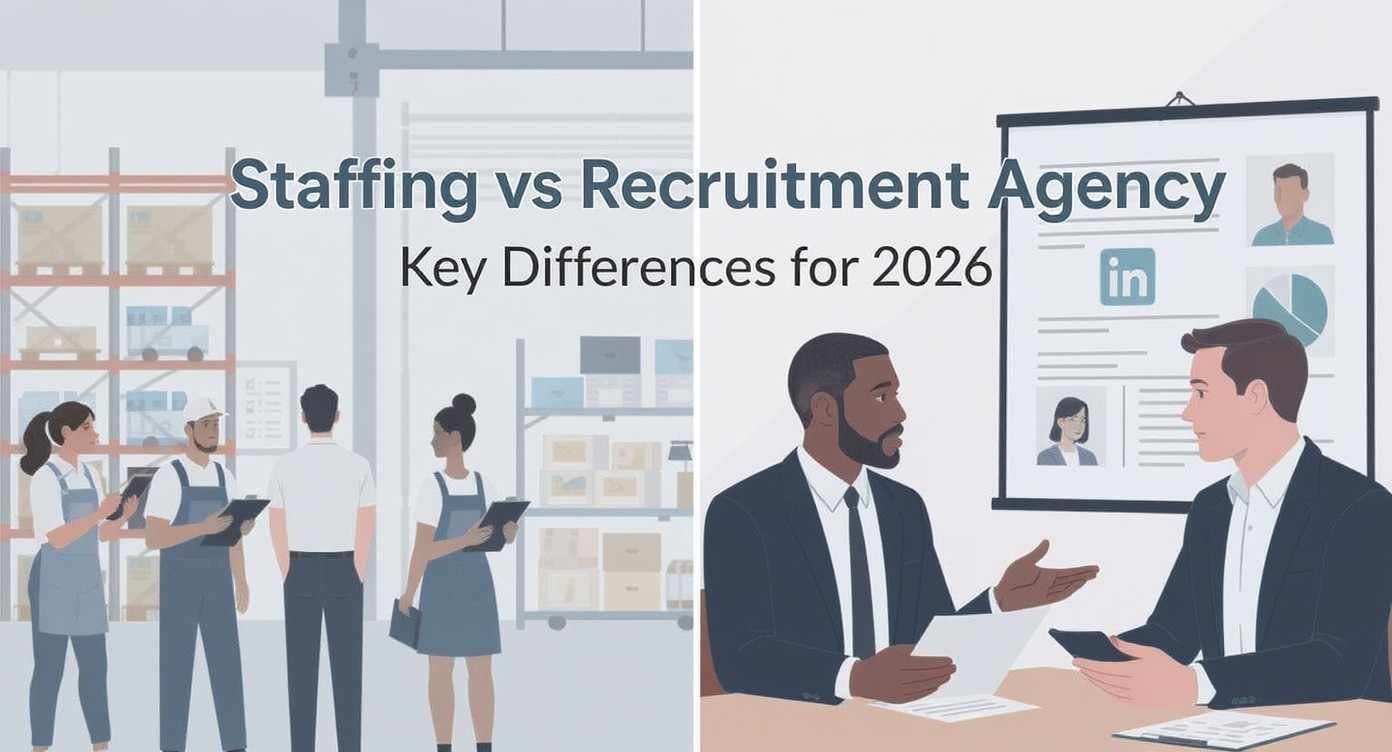
The main difference lies in the duration of the job and the depth of the search. A staffing agency focuses on short-term needs. They have a pool of workers ready to go for temporary vs. permanent placement needs. If a warehouse needs fifty people by Monday, they call a staffing agency.
A recruitment firm looks for long-term matches. They don’t have a “bench” of workers sitting around. Instead, they hunt for specific skills to fill a permanent role. This process is called talent acquisition. It is a proactive search rather than a reactive one. While staffing fills a gap, recruitment builds a team.
How Staffing Agencies Handle Workforce Management
Staffing agencies are the backbone of industries with fluctuating demand. They specialize in contract staffing and seasonal work. When you use a staffing agency, the agency often remains the employer of record. They handle the payroll, the taxes, and the insurance. You just pay the invoice.
This model is perfect for workforce management when your needs change weekly. Retailers use this during the holidays. Construction firms use it for specific projects. For the worker, it offers flexibility. You can gain recruitment agency Waco experience in different companies without committing to a single employer for years.
The Rise of Contract Staffing in 2026
We are seeing a massive shift toward “fractional” and contract roles. Companies no longer want to carry the heavy overhead of full-time benefits for every single task. Contract staffing allows you to bring in an expert for a six-month project. You get the results without the long-term liability. It is a lean way to run a business in a volatile economy.
The Recruitment Agency Strategy for Permanent Growth
When you need a new Director of Operations, you don’t post on a temp board. You hire a recruitment firm for direct hire services. These experts spend their time networking with “passive” candidates. These are people who already have jobs and aren’t looking, but would move for the right offer.
This is where headhunting vs mass hiring comes into play. A recruitment firm doesn’t want 500 resumes. They want the three best people in the country. They vet these candidates for culture fit and technical skill before you even see a name. You pay a fee, usually a percentage of the new hire’s first-year salary, once the person starts.
Why Talent Acquisition Differences Matter
You cannot treat a software engineer search the same way you treat a general labour search. Talent acquisition requires a deep understanding of the industry. Recruitment firms often specialise. Some only do tech. Others only do healthcare. This specialisation is why they find better people than a general HR department can. If you want to recruit top talent, you must use a specialised recruitment approach.
Temporary vs Permanent Placement: Pros and Cons
Choosing between temporary and permanent placement depends on your budget and your timeline. Temporary placements are fast. You can often get someone on-site within 24 hours. The risk is lower because you can end the contract at any time if the person isn’t a fit.
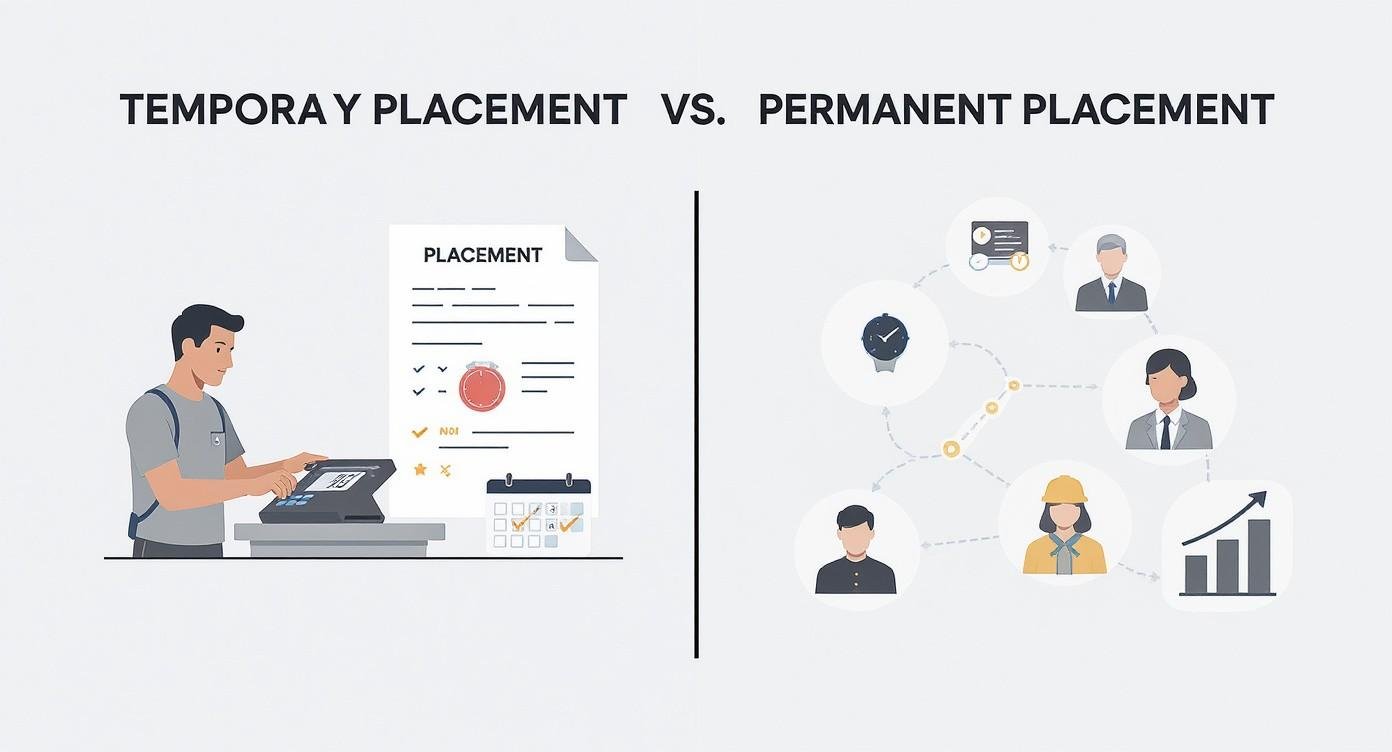
Permanent placement is an investment. It takes longer, often 30 to 90 days, to find the right person. However, the long-term value is much higher. Permanent employees carry the company culture and build institutional knowledge that temporary staff simply cannot.
- Temporary Pros: Speed, lower overhead, easy to scale down.
- Temporary Cons: High turnover, less loyalty, constant training.
- Permanent Pros: Stronger culture, long-term ROI, specialised skills.
- Permanent Cons: Higher upfront cost, longer hiring process, harder to terminate.
Headhunting vs Mass Hiring: Which Scales Better?
If you are a startup, you might need both. You might need to hire ten sales reps quickly, which is mass hiring. Or, you might need one legendary CTO, which is headhunting. Large organisations often use an employment agency vs recruitment firm simultaneously to cover different departments.
For those building something new, scalable recruitment solutions for startups are essential. You need a partner that can pivot from filling entries to finding leaders. Mass hiring relies on technology and volume. Headhunting relies on relationships and persuasion. Do not confuse the two, or you will offend the high-level talent you are trying to attract.
Understanding Direct Hire Services
Many people think all agencies keep the worker on their payroll. That is a myth. In direct hire services, the agency finds the candidate, but you hire them directly. They become your employee from day one. You pay the agency a one-time finder’s fee.
This is the preferred method for high-level roles. It shows the candidate that you are committed to their future. In 2026, candidates want stability. Offering a direct hire position gives you a competitive Recruitment Agency Arlington edge over companies offering “temp-to-perm” roles, which many top-tier professionals view as a red flag.
Employment Agency vs Recruitment Firm: Clearing the Confusion
The terms are often used as synonyms, but there is a slight nuance. An employment agency often works for the job seeker. They help people find work. A recruitment firm works for the employer. They help companies find people.
If you are a job seeker, you go to an employment agency to get your foot in the door. If you are a high-performing professional, you do not wait for a recruitment firm to call you. Knowing where you sit in this ecosystem helps you manage your career expectations.
Choosing the Right Partner for 2026
The economy is moving toward a hybrid model. We recommend a “Total Talent” approach. Use a Recruitment Agency Plano analysis for every department. Your IT team might need permanent recruits. Your warehouse or customer service team might thrive with a staffing model.
Check the track record of any partner you choose. Ask for their “fill rate” and their “retention rate.” A firm that fills a seat in two days but has the worker quit in two weeks is a waste of your resources. You want a partner that understands the local market and the global trends.
Summary of Staffing vs Recruitment Agency Models
To win in 2026, you must be agile. Staffing vs recruitment agency choice is the lever you pull to control your growth. Use staffing for speed and volume. Use recruitment for quality and leadership.
Stop settling for mediocre hires. Whether you need contract staffing for a quick project or direct hire services for a new VP, be intentional. Your team is the only thing that separates you from your competition. Hire like you mean it.
FAQ
What is the main difference between staffing vs recruitment agency?
Staffing handles short-term, temporary, or volume-based hiring where the agency often employs the worker. Recruitment focuses on permanent, long-term roles for highly skilled professionals.
Is a recruitment firm more expensive than a staffing agency?
Upfront, yes. Recruitment firms charge a percentage of the annual salary. However, staffing agencies charge a markup on every hour worked, which can be more expensive over a long period.
What are direct hire services?
This is a hiring process where an agency finds a candidate for a permanent role, and the company hires them directly onto their own payroll from the start.
Can a staffing agency provide permanent employees?
Yes, this is often called “temp-to-hire.” It allows the company to test a worker temporarily before offering them a permanent position.
Which is better for job seekers?
If you need a job immediately, a staffing agency is faster. If you want a career move with a higher salary and benefits, a recruitment firm is the better route.
